When we launched the Bondsavvy Basic service, our goal was simple: empower investors with smaller portfolios or those new to fixed income to maximize corporate bond returns without paying hefty fees to bond funds or traditional financial advisors. Through June 26, 7 of our 10 Bondsavvy Basic recommendations had outperformed the iShares LQD investment grade corporate bond ETF.
But individual bond investing isn't a "set-it-and-forget-it" strategy. Markets move, yields shift, and new opportunities emerge.
That is why, on June 30, we presented three new Bondsavvy Basic bond recommendations and will update all bond picks on July 14.
Get Access to Bondsavvy Basic for as low as $129: Join Bondsavvy Basic
Preview our initial Bondsavvy Basic investment grade bond recommendations
The price stability of our initial Bondsavvy Basic recommendations in the wake of volatile markets shows why they are a must-have in your investment portfolio. By comparison, Microsoft's stock price declined 22% from the bonds' December 12 pick date through June 26, 2026—and the Microsoft dividend yield is a paltry 1%. This stark contrast demonstrates the critical importance of owning high-quality individual bonds to protect your capital and secure high, reliable yields.
Our focus on independent, rigorous corporate bond analysis drives this outperformance while managing downside risk across market cycles. As shown in Figure 1a, our top performers achieved total returns through June 26 of +6.78%, +3.62%, and +3.53%. Our worst-performing bond returned -0.12%. During this period, iShares LQD generated a +1.66% total return.
Figure 1a shows our Bondsavvy Basic performance through June 26 and each bond's yield to maturity. Price changes have generally been limited, so these bonds can still be bought at good prices.
Figure 1a: June 26, 2026 Summary of Bondsavvy Basic Recommended Investment Grade Bonds
|
Industry |
Total Return
Through June 26
(Not Annualized) | June 26, 2026
Price Change Since Dec 12, 2025
Pick Date (Points) | June 26, 2026 Offer-
Side Yield to Maturity |
|---|
| Investment Grade Bond 1 | Technology | -0.12% | -1.41 | 5.71% |
| Investment Grade Bond 2 | Technology | +0.59% | -1.80 | 4.97% |
| Investment Grade Bond 3 | Energy | +6.78% | +3.27 | 5.73% |
| Investment Grade Bond 4 | Energy | +3.53% | +0.97 | 5.11% |
| Investment Grade Bond 5 | Consumer | +3.04% | Unchanged | 6.19% |
| Investment Grade Bond 6 | Consumer | +2.18% | -0.74 | 5.89% |
| Investment Grade Bond 7 | Consumer | +0.71% | -1.67 | 5.14% |
| Investment Grade Bond 8 | Healthcare | +2.22% | +0.01 | 5.76% |
| Investment Grade Bond 9 | Aerospace & Defense | +3.62% | -1.15 | 5.62% |
| Investment Grade Bond 10 | Aerospace & Defense | +2.19% | -0.23 | 5.17% |
| Median | | | -0.12 | 5.67% |
Source: YTMs and market prices provided on Fidelity.com and E*TRADE.
Please note that, while bond yields to maturity are an important metric, our active bond investing strategy seeks to achieve total returns that exceed a bond's purchase date yield to maturity.
Why Our July 14 Bondcast Presentation Matters
Building a resilient portfolio means looking forward, not backward, however. In our upcoming July webcast, we will review how the current economic environment and industry dynamics impact our issuing companies when we unveil updated buy/sell/hold recommendations for all 13 Bondsavvy Basic recommendations.
When: July 14 at 5:00pm EDT
What: We update all Bondsavvy Basic recommendations during The Super Bondcast, a webcast exclusively for Bondsavvy Basic subscribers.
How: We provide subscribers Zoom webcast details in advance of the presentation and will post a recording several hours after the live event concludes.
Bondsavvy Basic is separate from Bondsavvy Premier, a service we launched in 2017 that recommends both high yield bonds and investment grade bonds. The 92 Premier bond recommendations exited through May 1, 2026 had achieved a median annual return of 9.16% vs. 6.37% for the iShares LQD and HYG corporate bond ETFs.
Is Bondsavvy Basic Right for You?
If you want the principal protection, reliable income, and capital appreciation opportunities of individual corporate bonds but don't want to get overwhelmed by the 10,000+ choices available online, Bondsavvy Basic narrows the universe down to the most compelling options.
What you get as a subscriber:
- Bonds That Can Outperform: A tightly curated list of investment-grade corporate bonds across a diverse set of industry sectors.
- Deep-Dive Clarity: Access to our comprehensive video webcasts where we break down company financials, bond yield trends, and key risks in plain English.
- Continuous Execution: Ongoing quarterly live presentations where we refresh each buy/sell/hold recommendation based on quarterly financial results, bond price movements, and overall market conditions.
Investment grade bonds vs. high yield bonds
We have limited the scope of Bondsavvy Basic to include only investment grade bonds. For a bond to be deemed investment grade, it must have a minimum bond rating of Baa3 by Moody's and BBB- by S&P. Bonds with ratings below these thresholds, as shown in Figure 1b, are high yield bonds.

Bondsavvy Subscriber Benefit
Over 10,000 investment grade corporate bonds are available
for online investing each day. Our Bondsavvy Basic corporate bond recommendations cut through the clutter to identify bonds that
offer high coupons and upside potential relative to their risk.
Get Started Bondsavvy never relies on corporate bond ratings but rather conducts its own bond investment analysis when making new bond recommendations. That said, bond ratings do impact how bond prices move, and bond rating upgrade and downgrade thresholds are an important investment consideration.
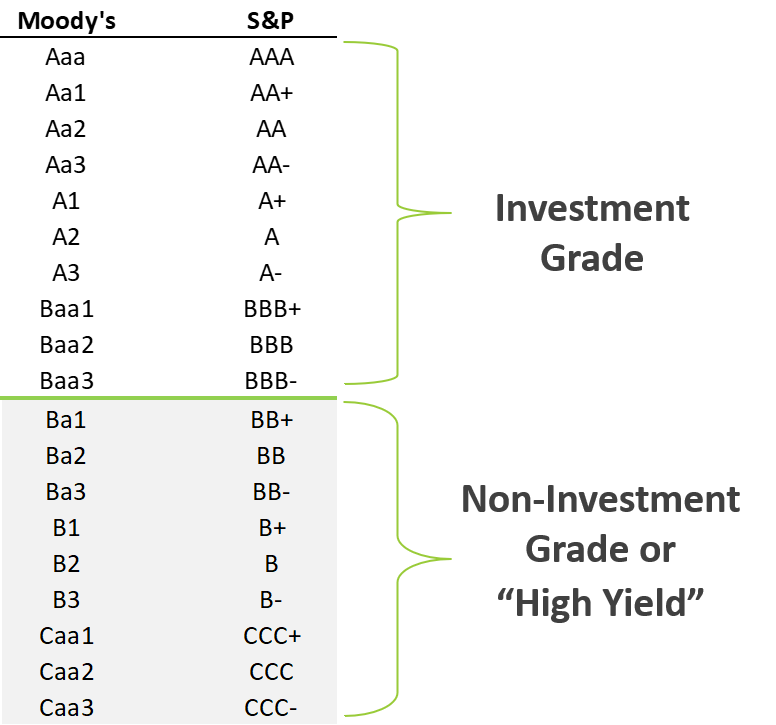
Key Differences Between Investment Grade Bonds and High Yield Bonds
For the twelve months ending May 31, 2026, US investment grade corporate bond issuance has been about five times greater than high yield bond issuance, as shown in Figure 2. Other key characteristics of investment grade bonds include longer initial tenors (the time until maturity), more favorable call provisions, and higher interest rate risk.
Figure 2: Investment grade bonds vs. high yield bonds
| Consideration | US Investment Grade Bonds | US High Yield Bonds |
|---|
| Term at issuance | Often 20 to 30 or more years | Typically 5 to 10 years |
| Call risk | Low - typically subject to bondholder-friendly
make-whole-call provisions | Typically subject to call schedules,
which limit bond price upside |
| Available bonds | About 10,000 bonds available when
buying bonds online | About 1,000 bonds available when
buying bonds online |
| 12 Months Ending 5/31/26 Issuance | $1,879 billion | $391 billion |
| Financial covenants | Typically limited | More restrictive, but deal dependent |
| Interest rate risk | Generally higher, but can be mitigated by
shorter-dated and higher-coupon bonds | Generally lower due to shorter maturities
and higher coupons (exceptions exist, however) |
Sources: SIFMA market data, Fidelity.com, and Bondsavvy
Investment Analysis Supporting Our Investment Grade Bond Recommendations
Bondsavvy simplifies bond investing by presenting easy-to-understand corporate bond recommendations. For Bondsavvy Basic's initial 10 investment grade bond recommendations, we recorded a 75-minute presentation covering our financial, investment, and business analysis supporting each recommendation. Below, we provide excerpts of the information we provide in Bondsavvy Basic.
Recommended Investment Grade Bonds to Buy
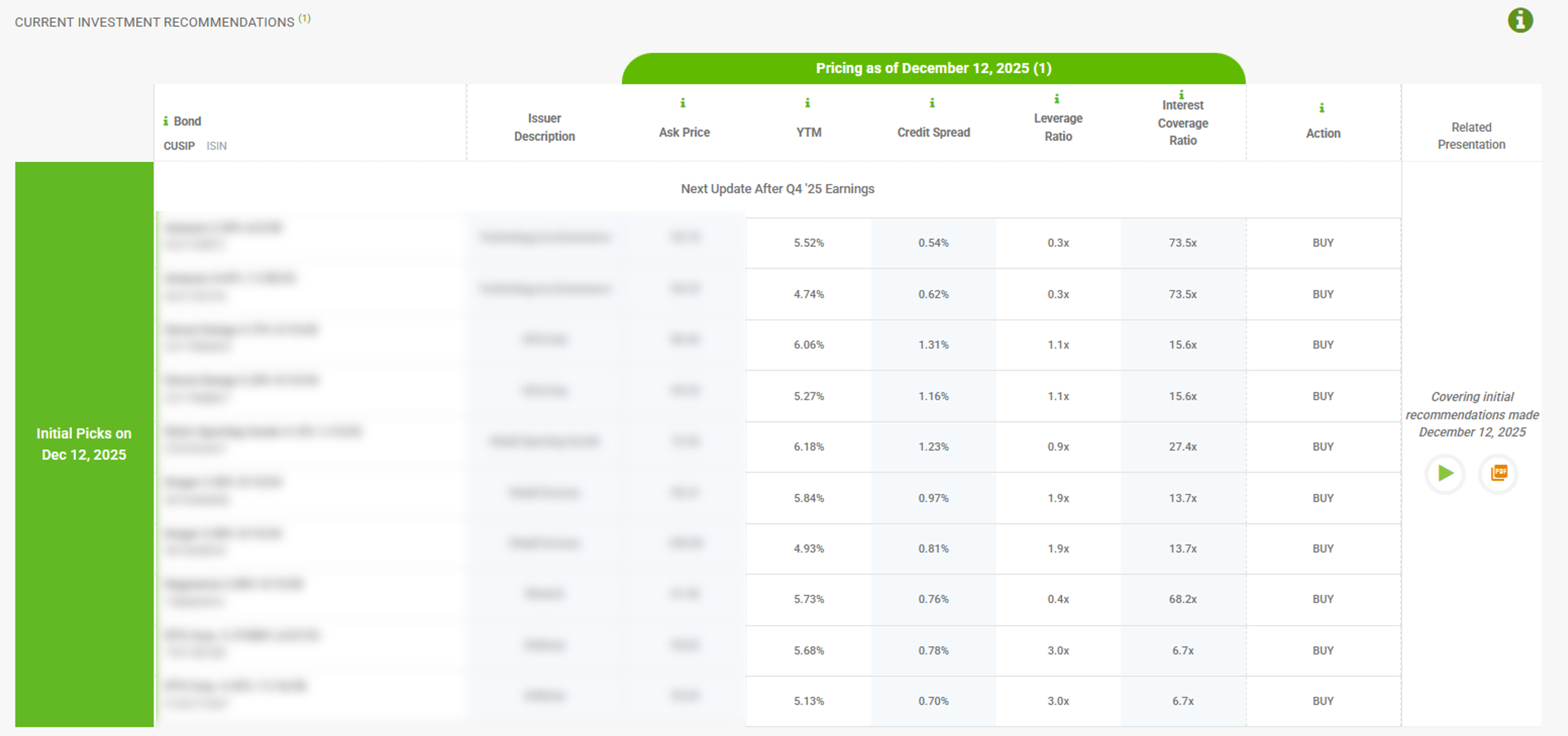
Upon logging into the Bondsavvy Basic investment service, subscribers will see the list of investment grade corporate bonds to buy, as shown in Figure 3. On this page, we show the bond's name, CUSIP, and ISIN (for non-US subscribers), as well as key pricing and financial metrics such as credit spreads and leverage ratios.
Figure 3: Bondsavvy Basic User Interface
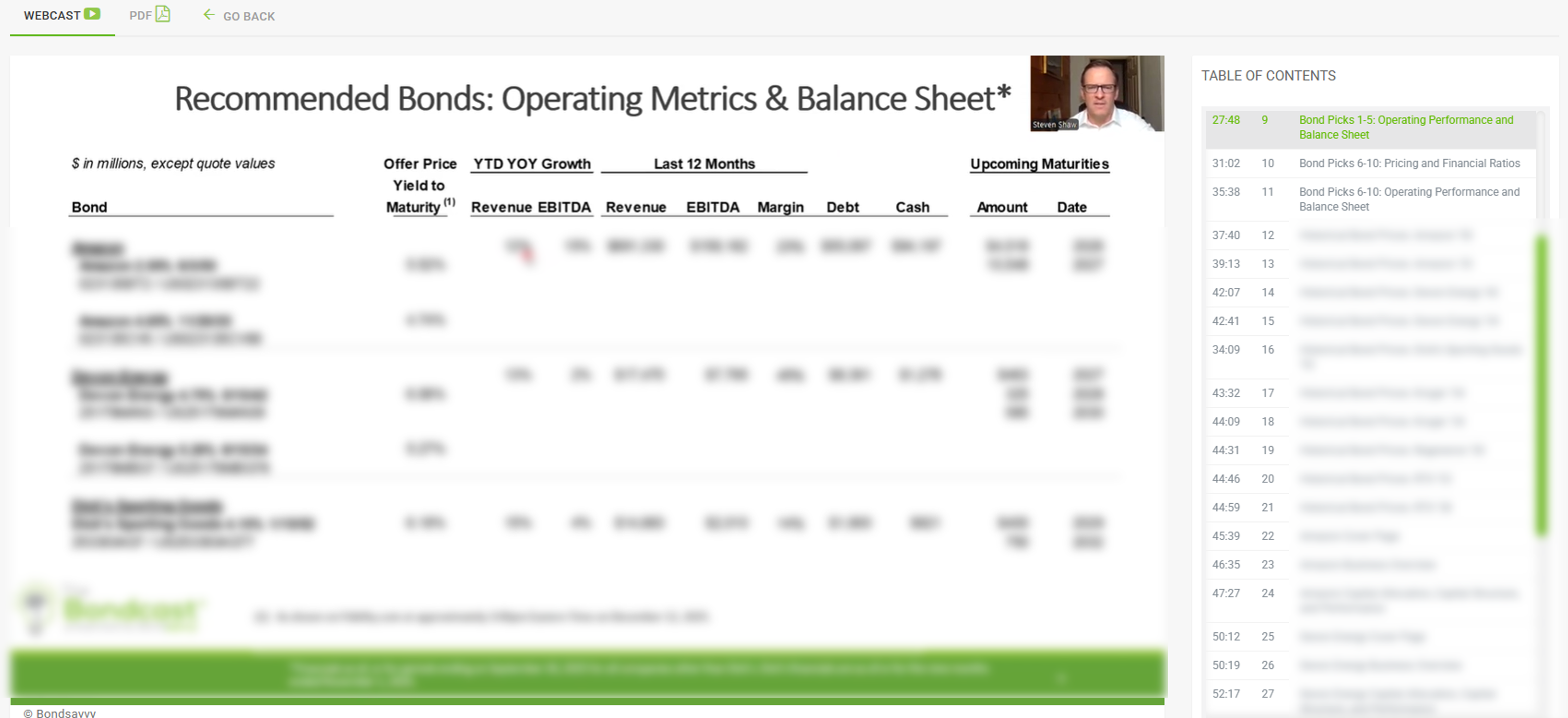
Bondsavvy Basic subscribers can access a chaptered 75-minute webcast for our initial bond recommendations. On the slide shown in Figure 4, Bondsavvy founder Steve Shaw is reviewing certain key financials of our issuing companies, including revenue and EBITDA growth, margins, cash vs. debt balances, and upcoming bond maturities. Subscribe to Bondsavvy Basic to learn each recommended bond and CUSIP number.
Figure 4: Excerpted Investment Grade Bond Investment Analysis in Bondsavvy Basic
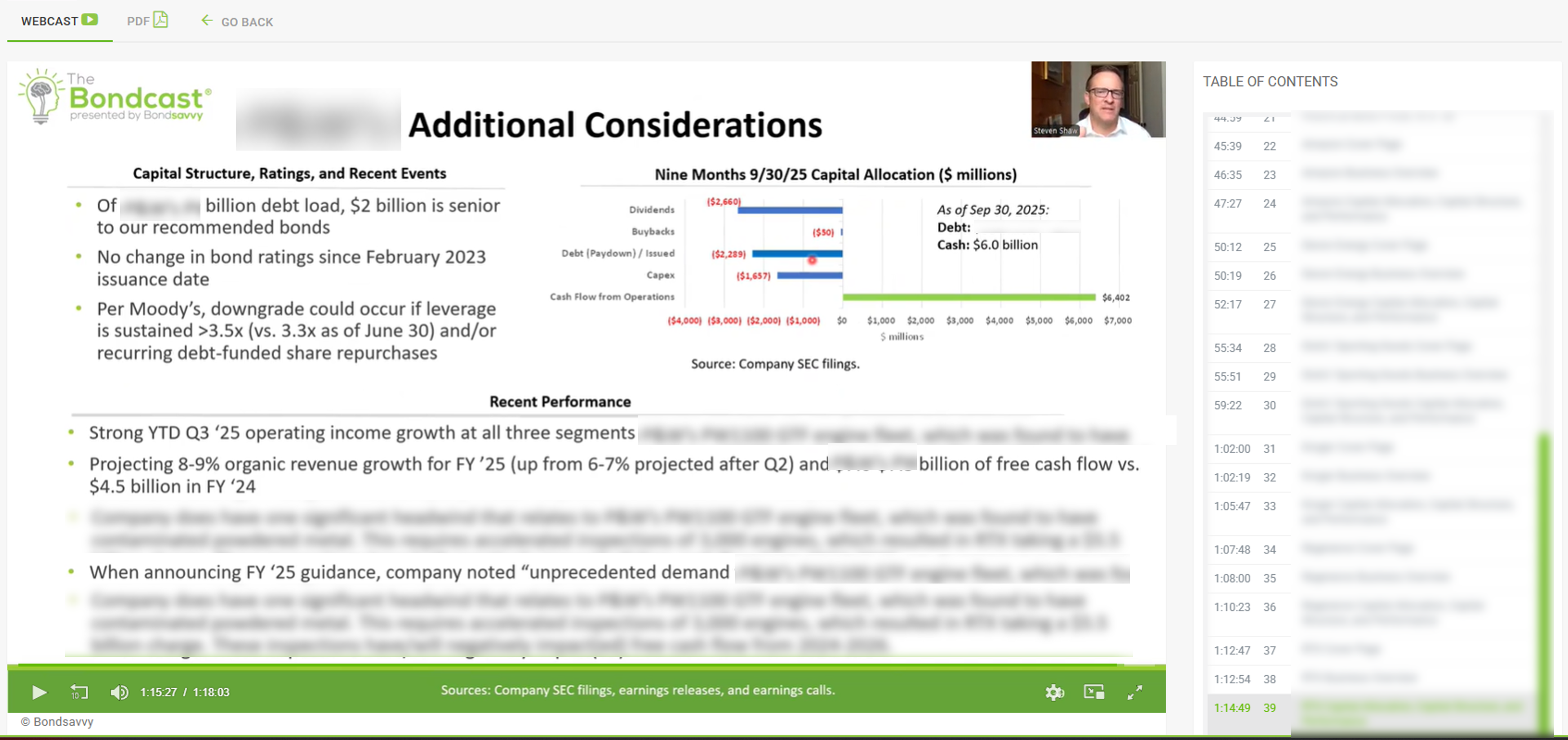
After comparing key financial ratios and metrics early in the presentation, we do a deep dive into each issuing company's business; trends; capital structure and capital allocation; and recent operating performance. We typically boil this down to two slides per issuing company, and we have attached a sample of one of these slides in Figure 5:
Figure 5: Bondsavvy Basic analysis of capital allocation, capital structure, and recent financial performance
Don't Miss Our Next Moves on July 14
The fixed-income landscape is shifting rapidly. If you have been waiting for the right moment to get started with individual corporate bonds, this is it.
By subscribing to Bondsavvy Basic today, you secure your spot for the live July 14 Super Bondcast Presentation, get immediate access to our current recommended list, and view the complete library of step-by-step investment analysis.
Take control of your portfolio, cut out the fund and advisor fees, and lock in competitive yields.
Choose My Plan
Watch Free Sample