Executive Summary
Key Takeaways: How We Saved FedEx Bondholders 7.7%
Why Corporate Bond Tender Offers Should Matter to You
Not all bond tender offers are worth accepting, but Figure 1a illustrates the importance of acting on tender offers when they are compelling. Before FedEx announced its $4.15 billion tender offer for 19 of its bonds on June 25, 2026, a customer sold the FedEx 4.05% '48 bond (CUSIP 31428XBQ8) -- one of the bonds included in the FedEx 2026 tender offer -- at 74.11. This was the last reported customer-sell trade before the June 25 tender-offer announcement.
Since the implied FedEx '48 tender-offer price based on the June 25 announcement was in the low 80s, the bond price increased to 81.92 on June 26, a nearly eight-point increase from where it traded on June 18. That significant a price increase over a short time period is notable in the land of corporate bonds.
In Figure 1a, the horizontal orange dotted line represents the "Early Tender Price" for the FedEx '48 bond, 79.92. This is the price investors who accepted the tender offer by the "Early Tender Time" received on the July 14 settlement date. As the bond was sold at 73.75 on July 15 -- one day after the tender offer settled -- investors continuing to hold the bond incurred a 7.7% capital loss, nearly two years' worth of the bond's coupon income.
Figure 1a: FedEx 4.05% 2/15/48 Reported Customer-Sell Trades
August 13, 2025-August 14, 2026
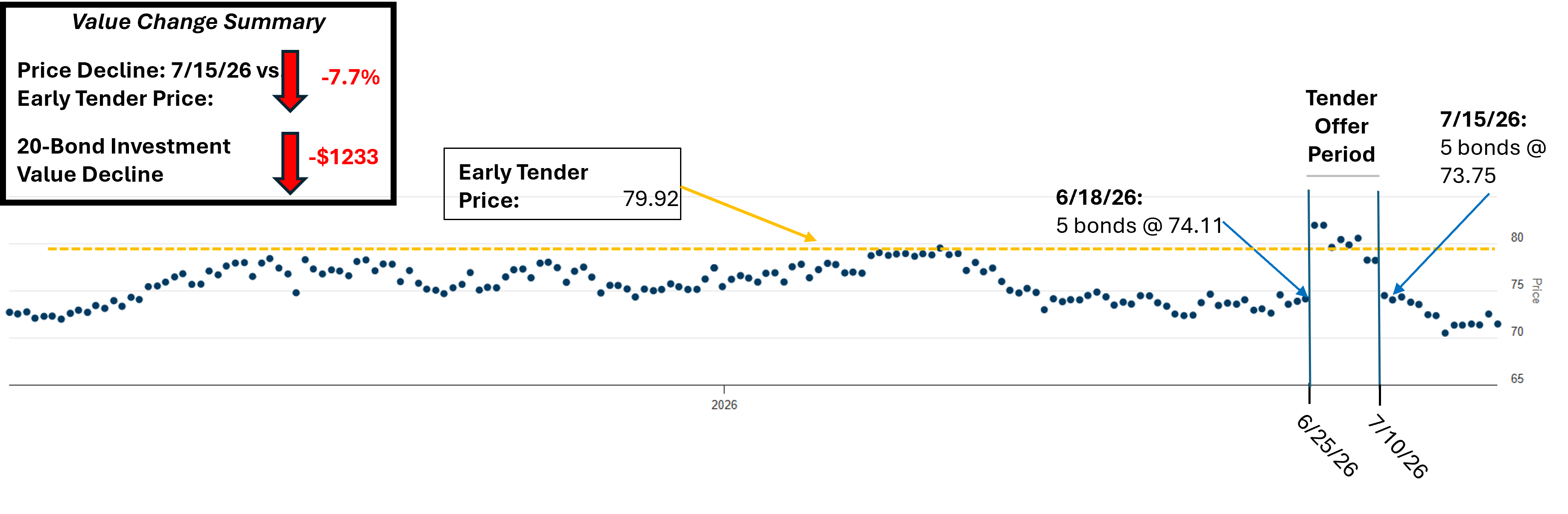
Source: The dots are FINRA TRACE market data presented on Fidelity.com. Additional figures and graphics added by Bondsavvy.
As shown above, the FedEx bond tender offer caused a significant increase in the FedEx '48 bond price. This occurred despite most long-dated investment-grade corporate bond prices falling from June 25 to July 7, 2026, as the 20-year US Treasury yield increased from 4.87% to 5.05%. July 7 was the deadline for retail brokerage customers to accept the tender offer to receive the Early Tender Price, which is only available to investors accepting the offer before the "Early Tender Time." There will be more on both of these terms and their timing later in this fixed income blog post.
Bondsavvy's Tender Offer Recommendations
So far in 2026, five of Bondsavvy's 67 recommended bonds to buy (7.5%) have been subject to corporate bond tender offers. We recommended accepting tender offers for two bonds (including FedEx '48) and rejecting tender offers for the remaining three bonds.
Bondsavvy subscribers are well equipped for "corporate actions" such as bond tender offers. Anytime there is a tender offer for a corporate bond we recommend, we provide subscribers with an "accept" or "decline" recommendation, which describes the bond tender offer's key terms, risks, and rationale behind our recommendation.
In the case of the FedEx '48 bond, we noted how compelling the offer was, as its implied yield was similar to that of a AAA-rated Apple bond. Please click to view the recommendation we provided Premier subscribers regarding the FedEx '48 bond's tender offer:
Low Early Tender Rates for 2026 FedEx Tender Offer
The Early Tender Price for FedEx '48 of 79.92 was 7.8% higher than the last customer-sell trade executed before the June 25 tender-offer announcement. Despite this, as shown in Figure 1b's blue box, only 23.4% and 58.0% of these bonds held by retail and institutional investors, respectively, were tendered.
To obtain the highest tender price possible for their bonds, FedEx bondholders needed to tender their bonds by the July 9 "Early Tender Time." While this was the official Early Tender Time, most brokerages required a decision by July 7.
As the tender offer included 19 series of bonds totaling $14.4 billion in face value outstanding, FedEx created "Acceptance Priority Levels" since the tender offer was capped at $4.15 billion in outstanding bonds (the "Tender Offer Cap").
Should investors, in aggregate, tender more than the Tender Offer Cap, the issuer first accepts Acceptance Priority Level 1, Acceptance Priority Level 2, and so on, until reaching the Tender Offer Cap.
Figure 1b shows the amount that was outstanding for each series of FedEx bonds in the first six Acceptance Priority Levels. As we discuss beneath Figure 1b, following a 2025 exchange offer related to the FedEx Freight spin-off, FedEx created retail-investor and qualified-institutional-buyer ("QIB") CUSIPs for the FedEx bonds. This enabled us to see the percentage of bonds tendered across all bond series, including how tender rates compared for retail vs. institutional investors.
Amounts Tendered for FedEx '48 Bonds
Prior to the tender offer, there were $1 billion outstanding of FedEx '48 bonds. Per Figure 1b, this included $256.6 million (25.7%) and $743.4 million (74.3%) of bonds held by retail investors and QIBs, respectively. As highlighted in the blue box, retail investors early tendered $60 million (23.4%) of their outstanding bonds while QIBs early tendered $431 million (58.0%).
Figure 1b: Tender Rates for 2026 FedEx Bond Tender Offer Priority Levels 1-6
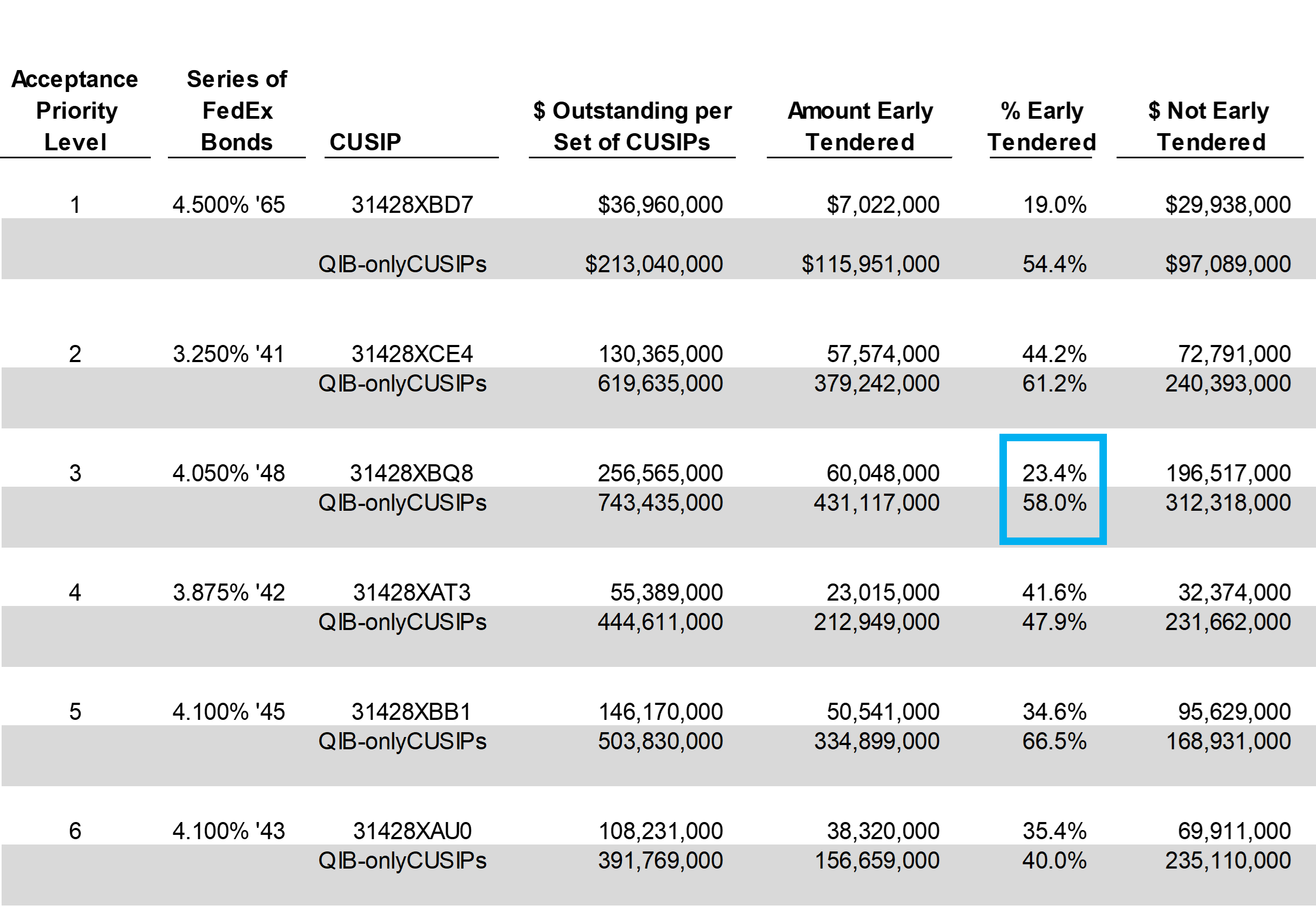
Sources: FedEx Corp. public filings and Bondsavvy calculations.
Investor Pain Points Driving Low Early Tender Rates
There's a problem when a tender-offer price is materially above where a bond has been trading, and retail-investor tender rates are 23.4%, as they were for the FedEx '48 bond. We believe the following retail-investor pain points can drive low retail-investor tender rates:
- Out-of-the-blue tender-offer notifications requiring often-unrealistic response times: Thanks to a June 30, 2026 SEC "Exemptive Order," debt tender offers now only need to remain open for a minimum of five business days. As brokerages often require customers to provide their acceptance notice two business days before the official deadline, this can result in retail investors having only three days to evaluate a tender offer. Keep in mind that most self-directed investors have day jobs and are not professional investors. Further, these tender-offer notifications come out of the blue with no advance notice as if self-directed investors are waiting by their computers for them. The FedEx tender offer occurred before the June 30 Exemptive Order, and individual investors had seven business days to respond to their brokerages.
- Not provided essential analysis to evaluate tender offers: While self-directed investors receive notifications about tender offers, they are often not equipped to make well-informed decisions on whether to accept or decline a tender offer. Often, they are directed to robust legal documents that were drafted to be understood by other attorneys -- not self-directed investors. With the exception of Bondsavvy's tender-offer recommendation analysis that focuses on its recommended bonds, we are not aware of value-added, easy-to-understand bond tender analysis geared toward self-directed investors.
- Most tender-offer prices float based on a little-understood framework: Most tender-offer prices are based on a "fixed spread" to the yield to maturity of a US Treasury with a similar maturity date of the bond being tendered. Many self-directed investors are not well versed with how US Treasury yields and credit spreads interact to drive corporate bond yields and, in turn, tender-offer prices.
- Hold-to-maturity investors leaving money on the table: Many financial advisors place their clients into bond ladders, which typically hold bonds to maturity at all costs. Bond ladders are generally a suboptimal investment approach that limits returns and increases risk. That said, even investors insistent on holding all bonds to maturity could have participated in the FedEx tender offer and then bought back similar bonds at a lower cost than the Early Tender Price.
Retail vs. QIB CUSIPs in the FedEx Bond Tender Offer
One wrinkle in the 2026 FedEx bond tender offer was that, for each series of bonds, there were four CUSIPs. Each set of four CUSIPs included one bond for retail investors and three for qualified institutional buyers, or "QIBs."
This is not common, but its occurrence provided a helpful perspective into individual- and institutional-investor behavior.
How did this "CUSIP proliferation" occur?
As part of the 2026 spin-off of FedEx Freight from FedEx Corp. ("FedEx"), FedEx needed to change certain terms of its bonds. To do so, in 2025, it effected an exchange offer only available to QIBs. The QIBs consented to the revised bond terms and, voila, they received bonds with new CUSIPs. As shown in Figures 1b and 1c, this allowed us to see the retail vs. institutional holdings of each FedEx bond series.
As noted earlier, there were 19 series of bonds included in the 2026 FedEx tender offer. As these 19 series of bonds represented $14.4 billion in face value outstanding and the Tender Offer Cap was $4.15 billion, only the first 11 series of FedEx bonds had tenders that were accepted by the company. Figure 1c shows Acceptance Priority Levels 7-11 and the corresponding tender rates for the retail and QIB-only CUSIPs.
As shown in the orange box, the blended tender rates for retail and institutional investors for the 2026 FedEx tender offer were 33.5% and 56.2%, respectively.
Figure 1c: Tender Rates for 2026 FedEx Bond Tender Offer Priority Levels 7-11
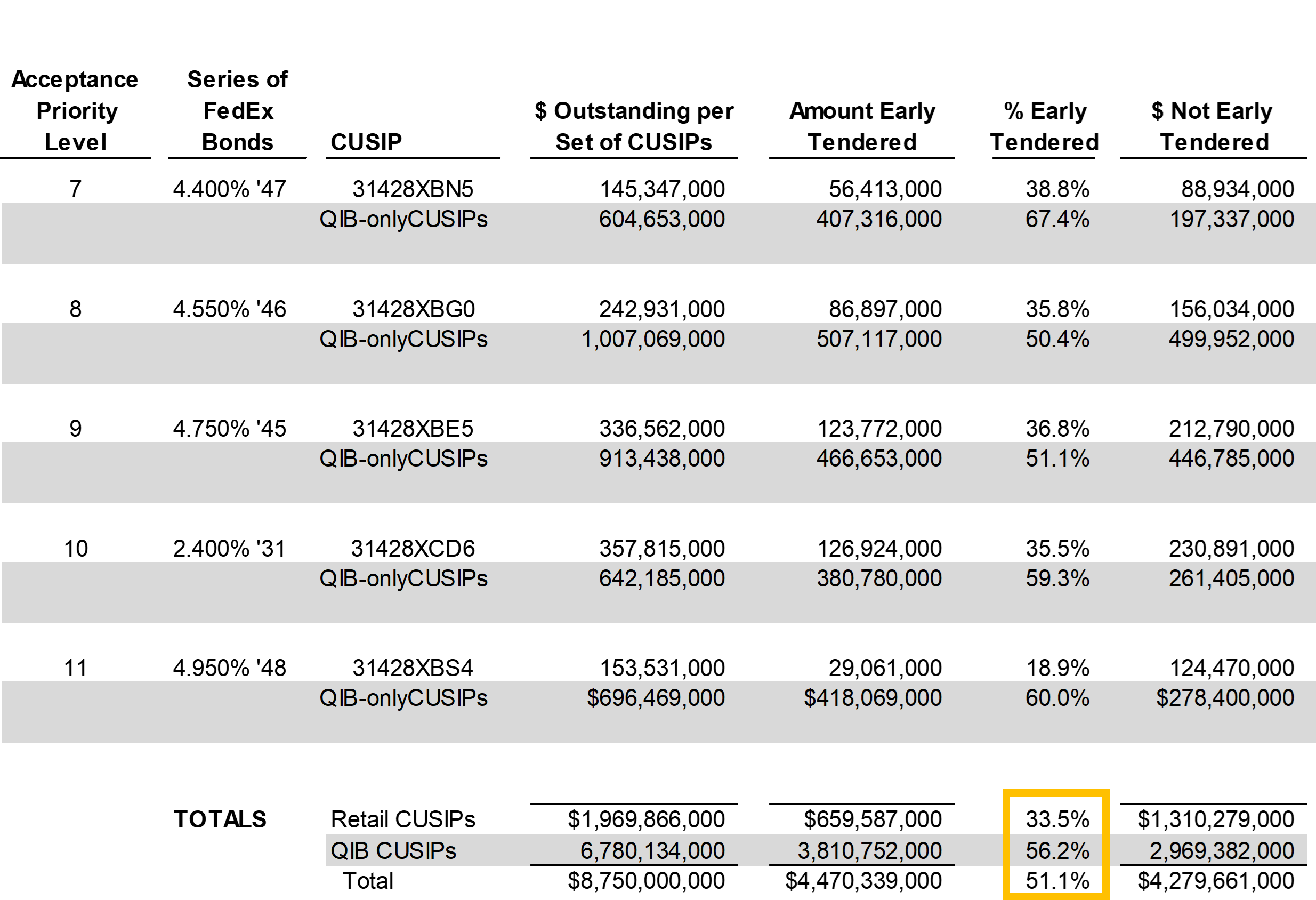
Sources: FedEx Corp. public filings and Bondsavvy calculations.
Tender Rates for Bond Funds and ETFs
We listed above certain reasons we believe there were low tender rates for FedEx bonds held by retail investors. While tender rates for institutional investors, or QIBs, were higher, they were still only 56.2% on a blended basis.
What were these institutional investors thinking?
Institutional investors are well equipped to decide whether to accept or decline a tender offer, but, for whatever reason, they decided not to take advantage of the FedEx bond tender offer. Earlier in the year, bond funds oddly fell over themselves to accept the Micron Technology tender offer, which included bonds paying around 6% issued by a company that had unmatched financial strength based on its latest financial filings.
One of the many benefits of owning individual bonds vs. bond funds is that investors know exactly what they're investing in and have control over their investments. With bond funds, investors cede control to a third party and have little knowledge -- and no control -- over what they do. For the 2026 FedEx bond tender offer, there will be no accountability for bond funds, as institutional investors have made it next to impossible for fund investors to know when certain bonds enter or exit a fund and the rationale for such moves.
The Opacity of Vanguard Bond Funds
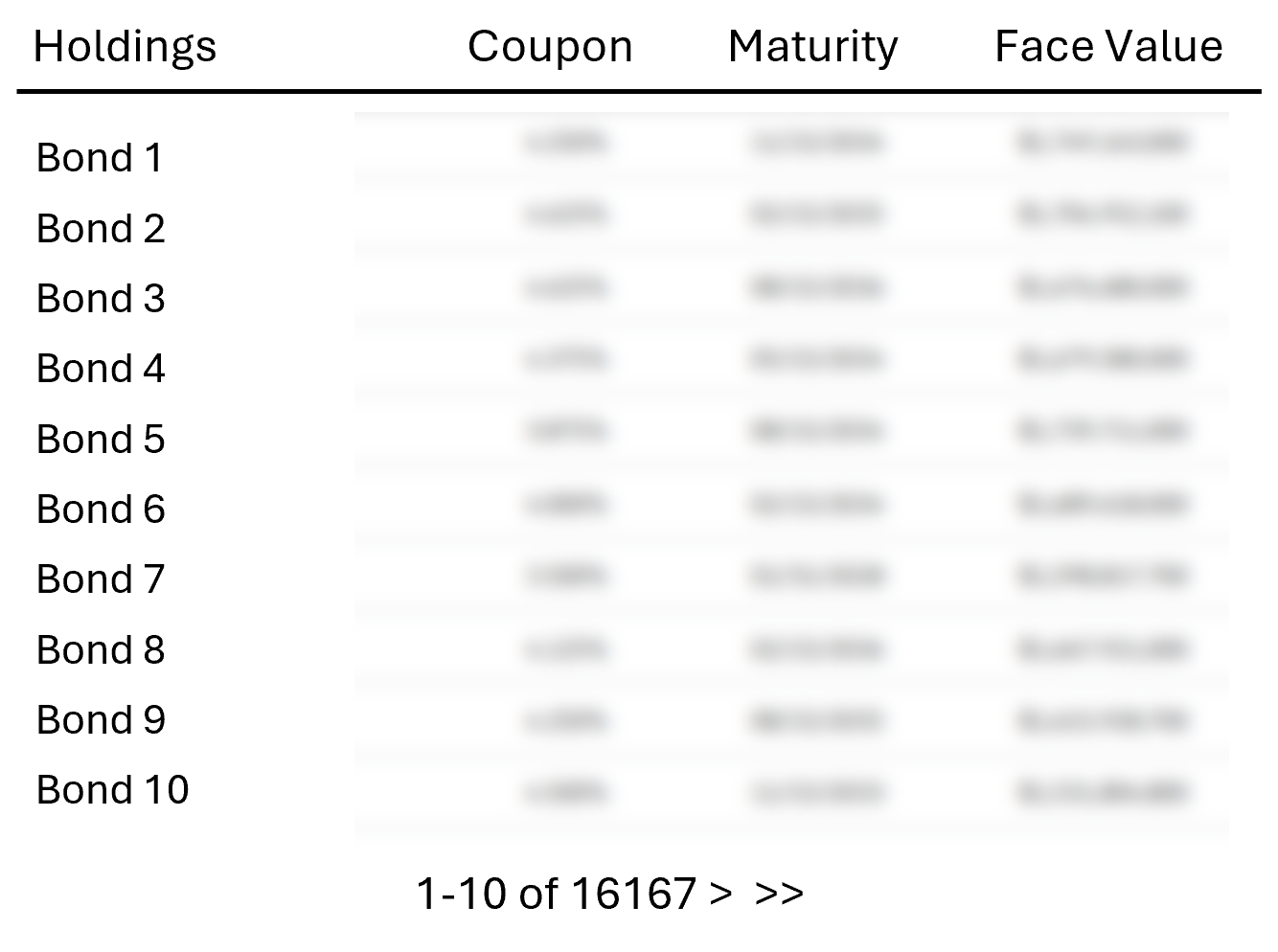
Vanguard bond funds are a good case study for where bond-fund lack of transparency lives. The $400 billion Vanguard Total Bond Market Index Fund (VBTLX) is one of the largest bond funds in the world. If you go to the Vanguard VBTLX website and scroll down to "Holding Details," you will see a list of its top-10 holdings. We aren't allowed to "reproduce, distribute, or disseminate" its portfolio holdings, but we have depicted how they show the holdings in Figure 1d.
To avoid transparency, Vanguard displays 10 bonds at a time. The fund held 16,167 bonds as of October 31, 2026, as shown at the bottom of Figure 1d. Therefore, investors wanting to see all of the bonds held by VBTLX would need to make 1,617 clicks.
Seriously?
If investors wanted to see changes from month to month, they would need to then copy and paste the information 1,617 times and then do the same thing next month.
Vanguard knows no investor in his or her right mind will do this, which is precisely the way the company keeps self-directed investors in the dark.
Figure 1d: Layout of Holdings for Vanguard VBTLX Bond Fund as of October 31, 2026
What's more, Vanguard inserts a hyperlink below its holdings, which launches a pop-up that includes these disclaimers:
"Vanguard may exclude any portion of these portfolio holdings from publication on this site when deemed in the best interest of the fund."
"The portfolio holdings are provided on a delayed basis and won't necessarily represent all of the actual investments held by the relevant Vanguard fund."
Investors seeking transparency and control can be well served owning a select portfolio of individual corporate bonds and avoiding opaque bond funds such as Vanguard VBTLX and similar investment vehicles.
TAKE CONTROL OF YOUR FIXED INCOME INVESTMENTS
Own Your Bonds.
Own Your Future.
Know exactly which bonds you own, why you own them,
and when it may make sense to sell.
-
✓
Build your own portfolio of individual corporate bonds
-
✓
Receive buy, sell and hold recommendations
-
✓
Stay informed as investment opportunities change
Explore Our Corporate Bond Recommendations →
Corporate Bond Tender Offers Explained
Companies use bond tender offers to redeem their bonds before maturity without having to pay a make-whole-call premium. Bondholders are not obligated to accept bond tender offers; however, as we will discuss later, these corporate actions can significantly impact the trading activity of bonds after the tender offer settles.
Later in this fixed income blog post, we will turn our attention back to the 2026 FedEx bond tender offer. Before doing so, however, we will discuss another significant tender offer that occurred earlier in 2026 for Micron Technology.
Micron Technology 2026 Bond Tender Offer
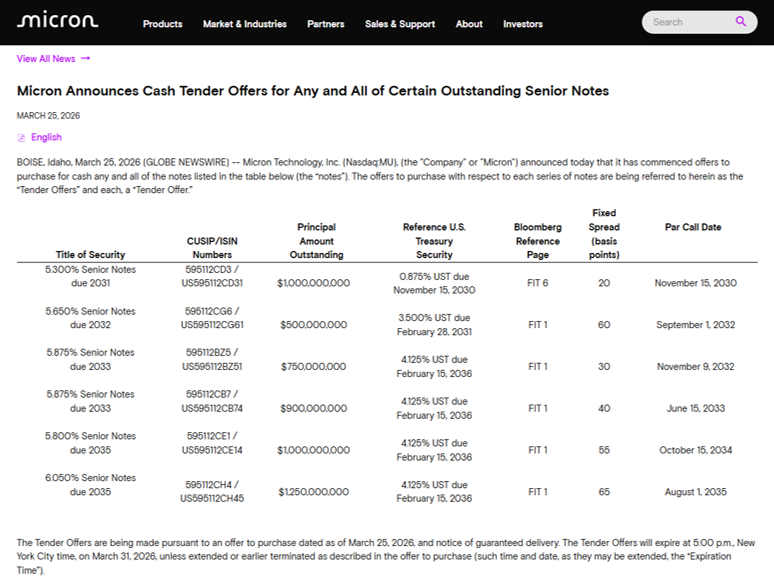
On March 25, 2026 Micron Technology announced a tender offer for "any and all" of six series of bonds outstanding, which totaled $5.4 billion. The six corporate bond CUSIPs were 595112CD3, 595112CG6, 595112BZ5, 595112CB7, 595112CE1, and 595112CH4. If you owned any of these bonds, you would have received a notification from your brokerage of the pending tender offer.
Micron Technology Bond Tender Offer Key Terms
One of the most-important parts of any corporate bond tender offer is: what's the tender offer price? With investment-grade corporate bonds, there's typically not an absolute tender price but rather a framework for how the issuing company will calculate the tender offer price. Figure 2 includes an excerpt from the Micron Technology tender offer announcement, listing each bond that was subject to the tender offer.
Per Figure 2, the announcement included two columns that would determine the tender offer price: the "Reference U.S. Treasury Security" column and the "Fixed Spread" column. For the Micron Technology 5.800% 2035 bond (the fifth bond on the list), Micron took the yield to maturity of the US Treasury 4.125% 2/15/36 note (the "Reference Yield") and added a spread of 55 basis points (or 0.55 percentage points).
Per a March 31 press release, the Reference Yield for the 5.800% '35 bond was 4.319%. The sum of 4.319% and 55 basis points is 4.869%, which was then converted into a price of 106.435. Investors can convert bond yields to bond prices by using the Fidelity bond price calculator or similar tools.
Figure 2: Key Terms of Micron Technology's March 2026 Bond Tender Offer
Source: Micron Technology press release: March 25, 2026.
Fixed vs. Floating Tender Offer Prices
As previously discussed, bonds with investment-grade bond ratings will typically have a variable tender offer price that will float based on the Reference US Treasury yield to maturity. In the case of the Micron tender offer, the offer expired March 31, which was six calendar days and four business days from the announcement date. Therefore, movements in the Reference U.S. Treasury Security yield between the date a bondholder tendered his or her bonds and March 31 would impact the final tender offer price.
For the Micron Technology 5.800% '35 bond, the 10-year US Treasury yield to maturity was little changed between March 25 and March 31, 2026, so the potential tender offer price did not move much during the tender period.
Corporate Bond Tender Offer Priority Levels
The Micron Technology tender offer was unique for bond tender offers in that it did not have "priority levels" for the offer. While six different Micron Technology bonds were subject to its 2026 tender offer, there were no priority levels. Rather, any bondholder wanting to tender his or her bonds could do so and not be subject to any limitations in this "any and all" bond tender offer.
The 2026 FedEx Tender Offer: A Recent Bond Tender Offer Example
On June 1, FedEx Corp. (“FedEx”) completed the spin-off of its FedEx Freight subsidiary. In connection with the spin-off, FedEx Freight paid a $4.1 billion cash dividend to FedEx. In turn, FedEx Corp. used this cash to redeem $4.15 billion of debt through a tender offer the company announced on June 25.
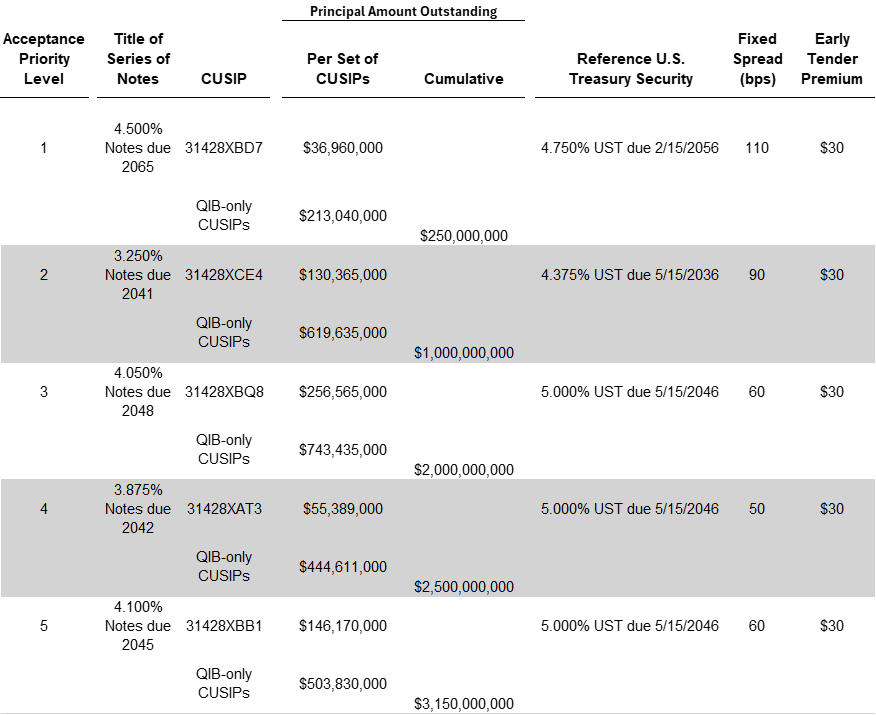
The 2026 FedEx tender offer was massive and far reaching, with 19 sets of bonds potentially eligible to participate. Since the total amount of principal outstanding for the 19 bonds was $14.4 billion (significantly exceeding the $4.15 billion redemption limit), the tender offer was subject to 19 “Acceptance Priority Levels,” which define the order in which bonds shall be redeemed should more than $4.15 billion of bonds be tendered.
Figure 3 shows the first five Acceptance Priority Levels, the amount outstanding for each bond, and each bond's tender offer pricing mechanism:
Figure 3: Excerpt from 2026 FedEx Tender Offer
Source: FedEx public filings and Bondsavvy calculations.
Evaluating the 2026 FedEx Bond Tender Offers
Comparing the FedEx '48 Fixed Spread to Its Historical Credit Spread
Apart from evaluating a bond tender offer's implied price as we did in Figure 1a, we can also compare the Fixed Spread being offered, per Figure 3, to the bond's historical credit spread. If the Fixed Spread is materially lower than the bond's historical credit spread, the offer will generally be compelling from a pricing perspective; provided, however, that there could be other reasons to decline the tender offer.
Bondsavvy updates its recommended corporate bonds to buy each quarter based on the most-recent issuer financial information, bond-pricing, yield, and credit-spread metrics. On the days of our quarterly updates during the year leading up to the FedEx tender offer, the FedEx '48 bond's credit spread had ranged from 1.01% (101 basis points) to 1.48% (148 basis points). Per Figure 3, the tender offer Fixed Spread for the FedEx '48 bond was 60 basis points. That the Fixed Spread of 60 basis points was materially below the bond's 101- to 148-basis-point credit spread indicates a compelling offer price.
Comparing the FedEx '48 Fixed Spread to the Apple '47 Credit Spread
Not only was the Fixed Spread much lower than the FedEx '48 bond's historical credit spread, but it was within spitting distance of the credit spread for the AAA-rated Apple 3.75% 11/13/47 bond (CUSIP 037833DG2). The small number of AAA-rated bonds typically have lower credit spreads than BBB-rated bonds with similar maturities due to the former's lower perceived default risk. If the Fixed Spread of a BBB-rated bond is near that of a AAA-rated bond, it's generally a compelling tender offer.
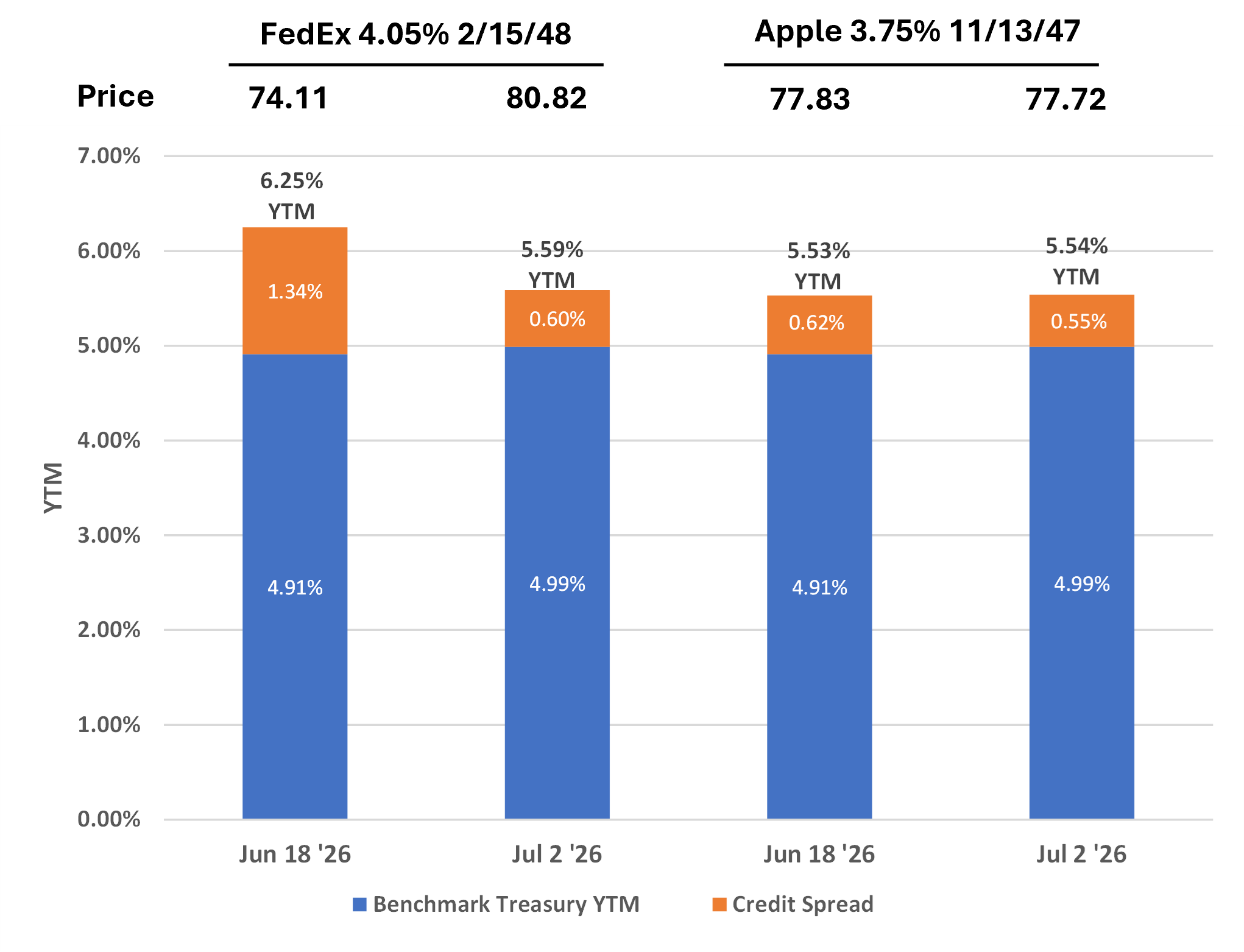
Figure 4 compares the building blocks of the FedEx '48 bond's yield to maturity ("YTM") to those of the Apple '47 bond. Each corporate bond's YTM has two components: 1) the benchmark US Treasury YTM and 2) the credit spread. The "benchmark US Treasury" is a US Treasury note or bond that has a similar maturity date to the specific corporate bond. As the FedEx '48 and Apple '47 bonds matured in about 20 years, the benchmark US Treasury was US Treasury 5.00% 5/15/2046 (CUSIP 912810UV8). The credit spread is the difference between a corporate bond's YTM and the benchmark US Treasury YTM.
Figure 4: Drivers of Movements in FedEx '48 and Apple '47 Yields to Maturity
Sources: US Treasury data. Bond YTM data provided by Fidelity. Additional calculations and graphics provided by Bondsavvy.
As shown in Figure 4, on June 18, the FedEx '48 bond's credit spread was 1.34% compared to 0.62% for the Apple '47 bond, a difference of 72 basis points. Following the June 25 tender-offer announcement, Bondsavvy provided its Premier subscribers its tender-offer recommendation on July 3. On this date, the Apple '47 credit spread was 55 basis points compared to the Fixed Spread for the FedEx '48 tender offer of 60 basis points. With the Fixed Spread within five basis points of the AAA-rated Apple '47 bond, it was further validation of the FedEx tender offer's compelling value.
Corporate Bond Tender Offer Timeline
Corporate bond tender offers begin with a press release followed by self-directed investors receiving a notification from their brokerages that a tender offer has begun. Brokerages will provide the deadline by when its customers must accept a bond tender offer. In our experience, the brokerage's deadline is typically two business days before the official tender deadline, or the Early Tender Time shown in Figure 5.
Bond tender offer timelines can vary, but Figure 5 shows the timeline for the 2026 FedEx bond tender offer. There's typically an "Early Tender Time," which provides extra compensation, generally $30 per $1000 face value per bond, for bondholders tendering their bonds by this deadline. For the 2026 FedEx bond tender offer, there was a final "Expiration Time" of 5:00pm on July 24; however, that deadline was irrelevant since $4.5 billion of bonds had been tendered by the Early Tender Time. This amount exceeded the Tender Offer Cap, so there were no other bonds accepted for tendering following the Early Tender Time.
Figure 5: 2026 FedEx Corporate Bond Tender Offer Timeline
| Date | Milestone | Description |
|---|
| June 25 | Announcement Date | FedEx issues a press release and files an 8-K laying out the tender offer terms. |
| July 9 @ 5:00pm EDT | Early Tender Time | Deadline for the issuing company to receive an investor's acceptance of the tender offer. |
| July 10 @ 10:00am EDT | Price Determination Time | When the issuer's bankers will calculate the early tender price for each CUSIP |
| July 14 | Expected Early Settlement Date | The date when bondholders can expect to receive money in their accounts and the bond redemption complete |
In the case of the FedEx bond tender offer, the Early Tender Time was the most-important milestone, followed by the "Price Determination Time." At 10:00am EDT on July 10, FedEx's bankers took the 20-year US Treasury yield of 5.075% (the "Reference Yield") and added the Fixed Spread of 60 basis points to arrive at a tender offer yield of 5.675%. This converted to price of $799.18 per bond or 79.92% of face value. As the Reference Yield for FedEx '48 of 5.075% was higher than the 4.99% 20-year Treasury YTM we showed in Figure 4, the final Early Tender Price of 79.92 was slightly below the 80.82 price we calculated on July 2.
Key Bond Tender Offer Considerations
Corporate bond issuers have, unfortunately, been using bond tender offers as an end run around key corporate bond call provisions, including the make-whole call. Institutional investors
- Tender-Offer Price: Tender offers neuter a key provision in corporate bond indentures: the make-whole call. Make-whole calls ensure bondholders are compensated for the present value of future bond interest and principal payments. As companies use bond tender offers as an end run around make-whole calls, we need to ensure the tender-offer price adequately compensates us. Earlier, we discussed how we evaluate the implied tender-offer price to recent trading activity, the tender offer's Fixed Spread vs. a bond's historical credit spread, and how the Fixed Spread compares to bonds issued by companies of higher creditworthiness.
- Long-Term Desirability of Bond: While price is a key consideration, it is not the only consideration. We believe in owning a select portfolio of individual corporate bonds we believe can outperform the market over the long term. There are many cases when a bond tender offer does not sufficiently compensate bond investors for the opportunity cost of surrendering a bond before maturity. This happened during the Micron Technology tender offer in March 2026, where Bondsavvy recommended subscribers to reject the Micron tender offer given the extraordinary strength of the company's financials and the high coupons our recommended bonds pay.
- Impact on Trading Liquidity After Tender Offer: If a bond has $1 billion outstanding and then $250 million outstanding the day after a tender offer settles, there will be a decrease in that bond's trading activity. It can be a wildcard as to how much this trading activity will fall, however.
- Bond Maturity Date: When trading activity declines, bid-offer spreads typically widen and, in some cases, it can become difficult to buy or sell a bond at a good price. The amount of post-tender-offer trading activity becomes more of an issue the further out a bond's maturity date is. If the bond matures in two years, provided no default, investors can have confidence the bond will return to par value in that time. If the bond matures in 20 years, it will take considerably longer, and investors can be left with difficult-to-sell positions in their investment accounts.
Choose My Plan
Watch Free Sample