A make whole call provision is an advantage corporate bonds have over municipal bonds, agency bonds, and brokered CDs. These provisions are favorable to bondholders, as they protect a bond's future income and maximize capital appreciation opportunities.
Municipal bonds, agency bonds, and brokered CDs, on the other hand, can typically be called at par value long before maturity. These onerous call provisions are significant disadvantages relative to corporate bonds. When so-called "fixed income" investments can be called at par long before maturity, they essentially take the "fixed" out of "fixed income."
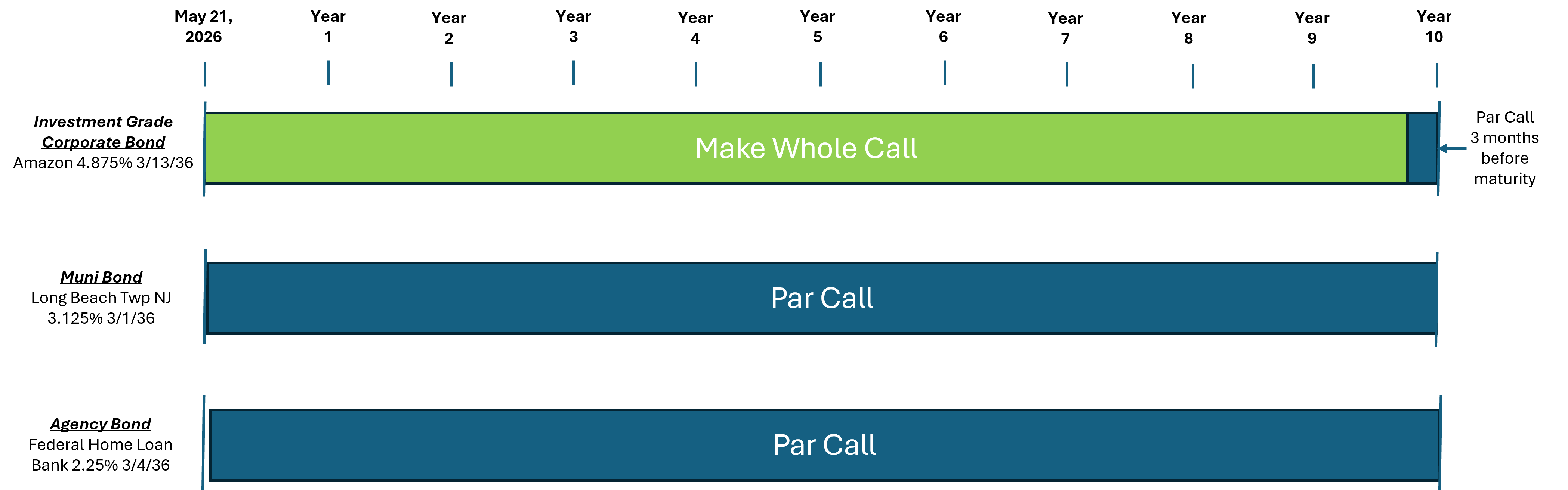
Figure 1 illustrates the difference in call provisions among three different 10-year bonds. These include a corporate bond (Amazon 4.875% 3/13/36), a municipal bond (Long Beach Township NJ 3.125% 3/1/36), and an agency bond (Federal Home Loan Bank 2.25% 3/4/36).
Figure 1: Comparison of Corporate, Municipal, and Agency Bond Call Provisions
Source: Call provision data provided in issuer filings and on Fidelity.com. All information graphed by Bondsavvy.
The Long Beach Township municipal bond (CUSIP 542552KH6) become callable at par value on March 1, 2026, a full ten years before maturity. The Federal Home Loan Bank bond (CUSIP 3130ALJJ4) will be callable at par value beginning June 4, 2026, nearly 10 years before maturity.
The Amazon '36 bonds, as we will discuss in detail later, is subject to a make whole call from issuance until December 13, 2036, three months before maturity.

Bondsavvy Subscriber Benefit
Steve Shaw founded Bondsavvy in 2017 to make bond investing simpler and more profitable for individual investors. Our corporate bond recommendations cut through the clutter to identify bonds that
offer high coupons and upside potential relative to their risk.
Get Started
Blindly investing in munis, agencies, and brokered CDs without appreciating the damage early par call provisions can do to investment returns is a big investor mistake.
What is a make whole call?
Make whole call provisions require bond issuers to "make bondholders whole" if they want to redeem bonds more than several months before maturity. To invoke a make whole call, issuing companies have to pay bondholders the present value of future interest and principal payments. This amount is called the "make whole payment."
Make whole call provisions are generally limited to corporate bonds; however, there is a key distinction between make whole call provisions found in investment grade and certain high yield bonds. For investment grade corporate bonds, the make whole provision lasts until the par call date, which is typically several months before the maturity date. Certain high yield bonds, on the other hand, are typically subject to make whole call provisions for several years after issuance. Thereafter, these high yield bonds are typically subject to a call schedule, where such bonds can be called at a specific price for several years leading up to maturity.
Please note that, while many high yield bonds are subject to a call schedule, there are also many that are not.
Since make whole call provisions for investment grade bonds typically last longer than they do for high yield bonds, investment grade bonds, depending on their maturity dates and other factors, can often see their prices rise higher above par value than is often possible with high yield bonds that are subject to call schedules.
We'll discuss more about call schedule bonds later in this fixed income blog post.
The make whole call calculation
To illustrate the make whole call calculation, we will use a specific individual corporate bond: Amazon Inc. 4.875% 3/13/2036 (CUSIP 023135DF0). This $6 billion Amazon '36 bond was part of a massive $37 billion bond issuance the company completed on March 10, 2026 to fund, in part, Amazon's projected $200 billion in fiscal 2026 capital expenditures.
Figure 2 provides a brief summary of certain key terms of the issuance:
Figure 2: Summary Select Terms of Amazon 4.875% '36 Issuance
| Term | Definition | Notes |
|---|
| Issue Date | March 10, 2026 | |
| Issuance Size | $6 billion | |
| Dated Date | March 13, 2026 | This is the date on which interest begins accruing. |
| Interest Payment Dates | March 13 and September 13 | Paid in arrears |
| Maturity Date | March 13, 2036 | |
| Par Call Date | December 13, 2035 | Company can redeem the bonds at 100% of par value beginning this date. |
| Optional Redemption | Can redeem bonds, in whole or in part, by paying the higher of (i) the present value of the
future interest and principal payments and (ii) 100% of the par value of the bonds. | Present value is based on discounting the future payments at the "Treasury Rate" plus 15 basis points. |
Source: Amazon Inc. prospectus dated March 10, 2026.
How To Calculate the Make Whole Call Payment
The Optional Redemption term in Figure 2 governs the make whole call calculation. The key to the make whole call calculation is the discount rate used to calculate the present value of the Amazon bond's future interest and principal payments. As shown in Figure 2, the discount rate is the "Treasury Rate" plus 15 basis points. Effectively, the Treasury Rate is the US Treasury yield for the US Treasury that matches the "Remaining Life" of the Amazon bond. The Remaining Life of the bond is the time period between the redemption date and the Par Call Date. To simplify, if there were 10 years of Remaining Life on the Amazon bond, the Treasury Rate would be the yield to maturity of the 10-year US Treasury, as shown in the Federal Reserve Select Interest Rates webpage.
In Figure 3, we assume the Amazon '36 bond is redeemed on September 13, 2026, 9.25 years before the Par Call Date. Under "Scheduled Payments," we show the Amazon bond's upcoming interest and principal payments. With a 4.875% coupon rate, Amazon pays $24.375 per bond every six months. We then calculate the present value of the interest and principal payments across three discount rate assumptions: 4.62%, 3.50%, and 2.50%.
Bondsavvy Subscriber Benefit
For Bondsavvy, educating investors doesn't stop with our blog posts. It is central to our mission and
our investment recommendation services.
Get Started
We show 4.62% as a discount rate based on the May 14, 2026 closing 10-year US Treasury yield of 4.47% plus 15 basis points. As shown in the green box in Figure 3, applying the 4.62% discount rate would result in a make whole call payment of 103.11 compared to the Amazon bond's 97.53 closing price on May 20, 2026, a 5.7% premium.
Figure 3: Illustrative Make Whole Call Calculation for Amazon 4.875% '36 Bond

Source: Bondsavvy calculations.
The Present Value by Discount Rate columns in Figure 3 illustrate why make whole call provisions are seldom invoked. Admittedly, the 103.11 make whole payment based on a 4.47% 10-year US Treasury yield is not onerous to the company. That said, there would be no rationale for Amazon to redeem the bonds at this price, as the 10-year US Treasury yield increased 32 basis points between the March 10, 2026 issuance date and May 14, 2026. Therefore, Amazon would have to pay a higher coupon rate on the bonds if they were issued today, as evidenced by the closing Amazon '36 offer-side YTM on May 20, 2026 of 5.18% compared to the bond's 4.875% coupon.
If 10-year US Treasury yields fell by slightly more than 1 percentage point and the discount rate was 3.50%, the implied make whole call payment would be 111.93. Lower US Treasury yields drive lower discount rates for the make whole call calculation and, therefore, higher make whole call payments.
Do all investment grade corporate bonds have make whole calls?
Bond terms are set when a bond is issued. When a corporate bond is issued with an investment grade bond rating, it will typically have a make whole call provision. Should that bond eventually be downgraded to below investment grade (a so-called "Fallen Angel"), the make whole call provision will remain. Therefore, investors can come across high yield corporate bonds, typically Fallen Angels, that have make whole call provisions.
On the other hand, high yield corporate bonds will typically have a make whole call provision for the first several years after issuance, but they will then be subject to a call schedule closer to maturity. Should a high yield bond be upgraded to investment grade, the call schedule remains in place. Therefore, there will be some investment grade corporate bonds that are subject to a call schedule, similar to the one shown below in Figure 4.
High yield bond call provisions
High yield corporate bonds are callable before maturity; however, their call provisions are more bondholder friendly than those for municipal bonds, agencies, and brokered CDs. First, high yield corporate bonds are generally subject to a make whole call for several years after the bond is issued. Then, as the bond gets closer to maturity, the bond will be callable at a premium to par value. As noted earlier, there are high yield bonds subject to make whole calls for nearly their entire term, such as certain BB-rated bonds.
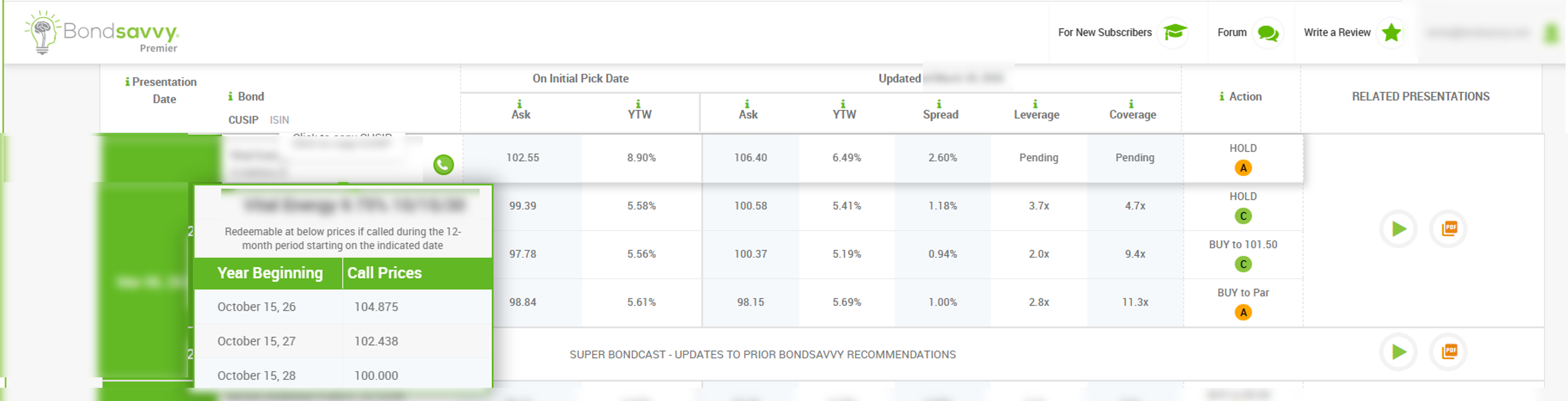
Figure 4 shows a small portion of the Bondsavvy Premier user interface. When a bond is subject to a call schedule, we indicate this with the green phone icon. Hovering over the icon will expose the bond's call schedule. In this case, a bond we recommended that was due in 2030 was initially subject to a make whole call. Then, beginning October 15, 2026, the bond was callable at a price of 104.875 (the "call price"). The call price declines after that, as the company needs to compensate bondholders for less foregone income.
In this case, the bond was callable at par a full two years before maturity.
Figure 4: Sample Call Schedule Shown in Bondsavvy Subscriber Area
With high yield bonds generally being subject to call schedules, their ability to increase in price well above par value can be limited. Please watch Part 1 and Part 2 of our yield to worst YouTube videos, which show how high yield bond call schedules can impact investment returns.
How to know if your bond has a make whole call
As noted above, bondholder-friendly make whole call provisions are typically limited to individual corporate bonds. Municipal bonds, agency bonds, and brokered CDs typically have onerous par call provisions that can take effect many years before maturity. Sometimes, these par call provisions kick in more than 10 years before maturity.
For Bondsavvy subscribers
Knowing bond call provisions is central to making successful bond investments. As part of the investment analysis we present Bondsavvy subscribers, we review the call provisions of each bond recommendation we make. If a bond is subject to a call schedule, we discuss that during The Bondcast presentation and show it on the bond recommendations tab within the Bondsavvy subscriber area.
Where to find summary bond call provision information
We highly recommend investors to buy bonds online to ensure the best prices and lowest fees. After logging into Fidelity.com, investors can click Accounts & Trade and then select "Trade" from the dropdown menu. In the "Trade" box, select "Fixed Income." You can then enter the CUSIP number under "Search by CUSIP." On the Bond Results page, click the hyperlink with the bond name under the "Description" heading.
In the Research & Quotes area, scroll to Redemptive Features and click the "View Schedule" hyperlink to see the bond's call schedule. If it's subject to a call schedule, you will see several call dates listed as well as call prices. These will typically start several years before maturity.
If the bond is subject to a make whole call throughout the life of the bond, the first call price shown will be 100.00 and the call date will generally be three to six months before maturity.
Where to find detailed bond call provision information
The information provided by online brokerages such as Fidelity.com is typically enough to provide the basic framework of a bond's call provisions. For more information, including the discount rate used to calculate the make whole payment, we review the bond prospectus. To find the prospectus, we first found the bond's issue date under "Bond timeline" in the Research & Quotes area on Fidelity.com. We then went to Amazon's investor relations website and clicked "SEC Filings." We then looked for SEC filings near March 10, 2026, the Amazon bond's issue date. The final prospectus for the $37 billion bond issuance was filed on March 12, 2026. In the prospectus, we searched for "Optional Redemption" to obtain additional details pertaining to the make whole call provision of the Amazon bonds.
Choose My Plan
Watch Free Sample
Baseball image licensed from Alamy.
There is no legal relationship between Bondsavvy and Fidelity Investments.